“Fear God and Be Whole”
Notes
Transcript
Most of us don’t walk around thinking of ourselves as fearful people.
We’re responsible. We’re busy. We’re trying to do life well.
And for a lot of you—especially young families—‘doing life well’ sounds like baby monitors, packed lunches, drop-offs, traffic, and practice schedules.
Whether you’re raising toddlers or launching teenagers, I’ve heard the same pressure in living rooms and hospital rooms: make your life count.
But underneath it all is a fear we know—even if we don’t call it fear.
The fear of insignificance. The fear that, at the end of all this effort, our lives won’t really matter.
And the quiet fear is this: what if it doesn’t add up?
In Midland, that fear hides behind good things—work ethic, responsibility, legacy. We want our lives to count.
So we stay busy. We stay useful. We stay needed.
And again—none of that feels wrong. In fact, it feels admirable. Mature. Necessary.
But if we’re honest, we’re scared that if we stop proving ourselves, we won’t matter. And it makes even good things feel urgent—like we’re always behind. And full disclosure, I wrestle with this all the time. I can preach this—and still be short in the kitchen by lunchtime.
That’s why it’s important to say this clearly, especially if you’re new to church or new to Christianity:
When the Bible says ‘fear God,’ it doesn’t mean panic.
It’s not fear of a moody god who’s out to get you.
And it’s not a vague “higher power.” It’s reverence for the living Creator who made you—and before whom your life is accountable.
And here’s the shock: this Creator has made himself known in Jesus.
We all live with fear. The question is: what are you fearing—and what is it doing to you?
Ecclesiastes doesn’t introduce fear into our lives. It redirects it.
And that’s the crucial turn we have to make as we approach the final words of this book.
Ecclesiastes doesn’t ask us to stop fearing. It asks us whether we’re fearing the right thing.
Or to say it plainly: are we fearing losing our life… or are we revering the One who gave it?
As Ecclesiastes closes, the Teacher repeats his theme:
“Absolute futility,” says the Teacher. “Everything is futile.”
“Futility” doesn’t mean meaningless. It means fleeting—like vapor. Here one moment, gone the next. Since I turned forty, this has stayed with me: life goes fast. Some days it feels like breath on a cold morning—there, then gone.
And by this point in the book, we know why the Teacher says it.
He chased wisdom—and it didn’t finally satisfy.
He tasted pleasure—and it didn’t last.
He devoted himself to work—and it couldn’t secure meaning.
Each pursuit promised fullness. Each one came up short.
Now, at the very end, there are no more experiments. No more searching. No more detours. This is the final accounting.
And before the Teacher offers any resolution, he lets the weight of reality press in.
Life ends. Strength fades. Control slips away.
And the question we’re left with is unavoidable:
If everything ends… what was it all for?
What made a life whole?
What gave it weight?
What made it matter?
The Teacher is about to give his final word.
And it’s not vague.
Life Disintegrates When God Is Not Central
Life Disintegrates When God Is Not Central
He doesn’t start with an argument. He starts with an invitation.
Ecclesiastes 12:1 “So remember your Creator in the days of your youth: Before the days of adversity come, and the years approach when you will say, “I have no delight in them”;”
“Remember” means more than recall. It means re-center your life on God. It’s not “don’t forget God.” It’s “live like God is real—and your life answers to him.” And Christians believe this Creator came near in Jesus.
The Teacher is saying: before time narrows your options, before strength fades, before life begins to close in—place God where he belongs.
And then, without warning, the Teacher moves into poetry—dense, unsettling, and honest.
He describes the fading of life through images that feel strange at first, but familiar once we slow down.
The light dims.
The guards of the house tremble.
The strong men stoop.
The grinders cease because they are few.
Those who look through the windows see dimly.
It’s the body aging—strength fading, senses dulling, life slowing down. Doors closing. Music growing faint. Fear grows—not because life is riskier, but because we’re weaker. If you’ve watched a parent age, you know this. I’ve sat in those rooms where the monitors beep and the words run out.
And if you’re a young parent, you’re feeling the other side of it: you watch your kids grow and you realize time isn’t just moving—it’s accelerating. One day you’re rocking them to sleep, and the next you’re watching them become who they’re becoming.
The Teacher isn’t mocking aging. He’s dignifying it by telling the truth.
And he keeps going.
Ecclesiastes 12:5 “Also, they are afraid of heights and dangers on the road; the almond tree blossoms, the grasshopper loses its spring, and the caper berry has no effect; for the mere mortal is headed to his eternal home…”
Eventually, the body gives way. The spirit departs. The dust returns to the ground from which it came.
Ecclesiastes 12:7 “and the dust returns to the earth as it once was, and the spirit returns to God who gave it.”
This is not cruel. It’s not cynical. It’s not despairing.
It’s honest.
Because here’s the key insight Ecclesiastes has been pressing toward all along:
Life feels fragmented because we try to build it without reference to its Creator.
It’s like building on a foundation you never check—until the cracks show.
When God isn’t central, everything else has to carry too much weight. Meaning becomes fragile. Success becomes temporary. Pleasure becomes hollow. Work becomes exhausting. And eventually, time exposes what we’ve been building on.
The problem Ecclesiastes exposes is not that life ends—but that we keep living as though it doesn’t.
And when we do, life doesn’t just end someday—it starts to unravel now.
We feel it in the fear of insignificance.
We feel it in the pressure to matter.
We feel it in the anxiety that time is running out and we’re not sure what it’s been for.
Ecclesiastes isn’t trying to scare you. It’s trying to spare you.
By facing death honestly, he makes room for wisdom. By naming our limits, he is preparing us to hear what actually makes life whole.
Because if life is fragile, temporary, and bounded—then meaning cannot be built on youth, strength, achievement, or control.
It has to be anchored somewhere deeper.
And that’s where Ecclesiastes takes us next.
Meaning Is Not Found in Delay, but in Alignment
Meaning Is Not Found in Delay, but in Alignment
After walking us through the fragility of life, the Teacher pauses—and reflects on his own role in the journey.
Ecclesiastes 12:9 “In addition to the Teacher being a wise man, he constantly taught the people knowledge; he weighed, explored, and arranged many proverbs.”
He’s earned the right to speak. The Teacher is not dismissing wisdom because he failed at it. He is not critiquing learning because he avoided it. He gave his life to it.
He studied carefully. He taught faithfully. He searched deeply. He chose his words with precision.
Ecclesiastes 12:10 “The Teacher sought to find delightful sayings and write words of truth accurately.”
In other words, Ecclesiastes is not the rant of a cynic—it’s the conclusion of a careful thinker. The Teacher did the work. He read the books. He tested the ideas. He pursued insight with discipline and integrity.
And then he tells us something striking.
Ecclesiastes 12:11 “The sayings of the wise are like cattle prods, and those from masters of collections are like firmly embedded nails.”
Wisdom does something. It pokes. It presses. It steadies. It gives structure. It keeps life from collapsing into chaos.
But then comes the warning.
Ecclesiastes 12:12 “But beyond these, my son, be warned: there is no end to the making of many books, and much study wearies the body.”
He’s not against learning—he’s against the illusion that learning saves.
The Teacher is saying: information never runs out—but meaning doesn’t automatically increase with it.
We know this instinctively.
We live in an age of endless learning:
Podcasts. Articles. Courses. Coaching. Self-improvement plans. Optimization strategies.
We’re always one book away from clarity.
One habit away from wholeness. One adjustment away from peace.
And yet—many of us are exhausted, trying to become whole at 1.5x speed.
Because effort can’t fix what’s mis-centered.
Here’s the key insight Ecclesiastes presses on us:
A life can be full of effort and still be misaligned.
You can look fine on the outside—and still be falling apart inside.
Wisdom is good—but wisdom cannot be ultimate.
Knowledge can guide—but it cannot ground.
Effort can refine—but it cannot redeem.
Ecclesiastes has been honest with us all along: Work didn’t finish the job. Achievement didn’t hold. And everything else failed for the same reason.
Why?
You can’t kick the can down the road and happen into meaning.
Meaning comes when life lines up with what it’s for. Here’s the difference: you don’t find wholeness by looking inward—you find it by returning to the God who made you.
A lot of so-called spirituality says, “Look inside…find your truth…center yourself…trust your instincts.” The Word of God says, “Look up! Remember your Creator!” If God is real, he doesn’t just join your journey—he defines reality.
That’s why the Teacher has led us here—slowly, patiently, relentlessly.
Not to leave us in exhaustion. Not to mock our striving. But to clear the ground.
Because after all the searching, after all the testing, after all the wisdom, after all the words, the Teacher is finally ready to tell us what the whole thing was about.
And when he does, he won’t hedge. He won’t soften it. He won’t delay it.
He will give us the verdict.
Wholeness Comes From Fearing God
Wholeness Comes From Fearing God
After all the searching, the questioning, the testing, and the honesty—Ecclesiastes finally stops circling and speaks plainly.
Ecclesiastes 12:13 “When all has been heard, the conclusion of the matter is this: fear God and keep his commands, because this is for all humanity.”
He’s earned this conclusion. And if you’re new to faith or just exploring Christianity, think of it this way: God isn’t asking you to panic—he’s inviting you to come back under his good authority.
Ecclesiastes won’t let us settle for “be spiritual.” The Teacher is talking about the real God—Creator and Judge—whether we acknowledge him or not.
So the question isn’t, “Are you spiritual?” It’s, “Are you right with God?”
And Christians believe reconciliation is not something we achieve by effort or enlightenment—it is something God gives us through Jesus Christ.
Twelve chapters of reflection funnel into one clear verdict. This is not a suggestion. It’s not a proverb. It’s not a strategy. It’s the Teacher saying, “Here it is. This is what the whole thing was about.”
And for many people—especially those newer to church—this word fear can feel unsettling. It can sound like intimidation. Like threat. Like living on edge before an angry God.
But that’s not what Ecclesiastes means. And it’s not how Scripture uses the word here.
To fear God is not terror—it is right placement.
It’s awe and humility—knowing you’re not God. It is trusting that God’s authority over my life is not dangerous—but good. It’s the difference between living like I’m in charge—and living like God is.
To fear God means I finally stop pretending I’m ultimate.
I stop trying to carry what I was never designed to hold.
I stop building my life as if everything depends on me.
And here’s the surprising thing Ecclesiastes wants us to feel: That’s not oppressive. That’s relieving.
Because when God is feared rightly, life begins to cohere.
The fragments start to align.
Meaning no longer has to be manufactured.
Worth no longer has to be proven.
Control no longer has to be maintained.
Obedience isn’t earning approval. It’s living in line with reality. Living in step with the grain of the universe God designed.
In other words: this is how life works.
And then the Teacher adds one final line—one that often makes people uneasy:
Ecclesiastes 12:14 “For God will bring every act to judgment, including every hidden thing, whether good or evil.”
That word judgment can sound frightening if we hear it as condemnation first.
But Ecclesiastes frames it differently.
Judgment here is not meant to terrify—it’s meant to give weight.
Without judgment, nothing has weight. For Christians, judgment drives us to grace.
Without accountability, good and evil blur.
Without an ultimate reckoning, injustice wins.
Without God’s final word, our lives dissolve into accident and absurdity.
Judgment means your life is not meaningless. Your choices are not invisible. Your faithfulness is not wasted. Your suffering is not forgotten.
So we don’t try to balance the scales—we run to mercy.
It means the universe is moral. It means God cares. It means the story is going somewhere.
And here’s the quiet relief beneath it all:
If God is the one who judges, then I don’t have to be.
I don’t have to prove I matter. I don’t have to fear insignificance—because I already stand before the One who gives life meaning.
This is why Ecclesiastes ends here.
Not with despair. Not with resignation. But with wholeness.
To fear God is to live in reality.
To fear God is to be rightly placed.
To fear God is to finally be free from the exhausting task of being at the center.
And when that happens—life may still be hard. But it is no longer hollow.
Because the fear of God doesn’t shrink life.
It gives it weight.
It gives it meaning.
It makes it whole.
Ecclesiastes doesn’t end by telling us to fix ourselves. It ends by inviting us to tell the truth.
The Teacher has shown us where life fragments—when God is not central, when meaning is delayed, when alignment is postponed. And now the question is not, “What should I do next?” but “What has been shaping my life all along?”
Because fearing God is not a religious add-on. It’s a re-centering.
So before we rush toward resolve, Scripture invites us to pause long enough to notice where our lives may be out of alignment.
Not in a condemning way. In an honest way.
Ask yourself—slowly, prayerfully:
Where is my life misaligned? Not where it’s messy—but where it’s drifting. Where God is acknowledged but not actually centered.
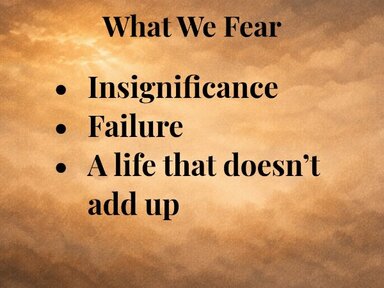
What do I fear more than God? Fear of failure? Fear of insignificance? Fear of disappointing others? Fear of being exposed? Fear of being forgotten?
What have I built my sense of worth on? Productivity? Reputation? Control? Stability? Being needed?
Because whatever we fear most is quietly shaping what we obey. And whatever we treat as ultimate will eventually ask more from us than it can give.
For some of you, this shows up in very ordinary places:
the way bedtime becomes a battleground because you’re exhausted and scared you’re failing
the way money feels like constant pressure—mortgage, daycare, groceries, the next surprise bill
the way your phone keeps you “in the loop,” but it also keeps you restless
the way your kids’ future feels like a weight you can’t set down
And Ecclesiastes is saying: you were never meant to carry ultimate weight.
Ecclesiastes is not asking us to feel bad for being human. It’s asking us to stop asking created things to carry divine weight.
Let me say the bottom line here, gently, because it frames this moment without pressure:
Wholeness comes from fearing God.
Wholeness comes from fearing God.
Not because God is demanding—but because God is real. Not because life becomes easier—but because life becomes aligned.
And alignment always begins with awareness.
So don’t rush past what the Spirit may be surfacing. Don’t correct it yet. Just name it.
Because once we see where our fear has been misplaced, we’re finally ready to hear the gospel—not as information, but as rescue.
Ecclesiastes ends with a command—but the gospel tells us how that command can actually be lived.
Because if we’re honest, fearing God perfectly feels impossible.
Living fully aligned feels out of reach.
Standing before judgment feels overwhelming.
And that’s exactly where Jesus steps in.
Here is the hope Ecclesiastes prepares us for:
Jesus feared God perfectly. His life was lived in reverent awe, complete trust, and total obedience. He never displaced the Father. He never sought meaning apart from God’s will.
Jesus lived fully aligned. No fragmentation. No divided loyalties. No false centers. His life moved in harmony with the Father’s purposes—every step, every word, every choice.
Jesus faced judgment on our behalf. Ecclesiastes tells us that God will bring every act into judgment. The gospel tells us that Jesus stepped into that judgment for us. He bore what we could not. He carried what we could not survive.
Jesus restores what sin fractures. Where sin disintegrates life, Christ reunites it. Where fear scatters us, Christ gathers us. Where guilt distorts us, Christ makes us whole again.
Jesus isn’t just a teacher. We’re talking about God the Son, come near—taking flesh and standing in our place. He’s not a helper. He’s the Lord who came to save. Jesus isn’t one option among many—he’s the only Savior.
Here’s the line I want you to hear clearly:
The One who calls us to fear God is the One who bore judgment so we could be made whole.
At the cross, Jesus carried our guilt so we could be forgiven.
Jesus does not stand over Ecclesiastes and scold us. He fulfills it.
What we couldn’t earn, Christ gives by grace.
Meaning. Belonging. Wholeness.
Not because we finally get life right—but because he has.
And that changes everything about how we hear this call.
We are not being invited into fear without mercy. We are being invited into alignment through grace.
So how do we respond?
Not with panic. Not with promises. Not with pressure.
We respond by yielding to God.
This isn’t self-improvement. It’s surrender.
To fear God is to say:
“I am no longer the center.”
“I no longer trust myself to carry what only God can hold.”
“I am placing my life—my future, my worth, my fears—back where they belong.”
This is not shrinking your life. It is reordering it.
And here’s the invitation—spoken carefully, especially for those still exploring faith:
To fear God is not to live smaller. It’s to finally live whole.
Some of you may need to yield control.
Some of you may need to release fear.
Some of you may need to entrust your life to Christ for the first time—not with full understanding, but with honest dependence. If you’re coming from another belief system, hear me: I’m not asking you to add Jesus—I’m asking you to trust him.
And for others, this may be a quiet re-alignment—a returning of the heart.
Let me say the bottom line one more time, clearly and confidently, because this is what we carry with us:
Wholeness comes from fearing God.
Wholeness comes from fearing God.
—not fear that runs away, but fear that comes home.
So as we respond, don’t rush.
Don’t perform.
Don’t resolve everything.
Simply yield.
And trust this: The God who calls you into reverent awe is the same God who, in Christ, is already working to make you whole.
